

First, two new Mini-Interviews!
First: Daniel Kalban is currently doing a Kickstarter for more of his comic AMERICAN DREAMS…
Read more: Two New Mini-Interviews– and Part One of THE HAMLET PAPERS
–Question: What is your favorite word?
–DK: Rose
–Question: What is your least favorite word?
–DK: Moist
–Question: What sound or noise do you love?
–DK: The sound of a symphony
–Question: What profession other than your own would you like to attempt?
–DK: Film Director or Archaeologist (my dream jobs as a kid)
–Question: Please talk about your current writing project…
–DK: American Dreams is set in the Gilded Age where Jewish immigrant Jake Gold has become the superhero known as Liberty. In our TWO new issues, Liberty has to deal with the fallout at a brawl during a parade that has given Aleister Crowley an opening to exploit tensions and fears to spread chaos across the city. With our two new issues, we also have catchup tiers. It’s superhero action, political commentary (without being too lecture-y), and Jewish representation all in one exciting package.
https://www.kickstarter.com/projects/americandreamscomic/american-dreams-issues-1-8
And now, comics creator Kathryn Calamia, currently doing the Kickstarter for Hallowed Ground – An Afterlife Horror Comic Anthology— A 100+ Page Horror Anthology. Twelve stories of HELL, PURGATORY, and HEAVEN, from LGBTQIA+ Creative Teams!
https://www.kickstarter.com/projects/deathline/afterlife1
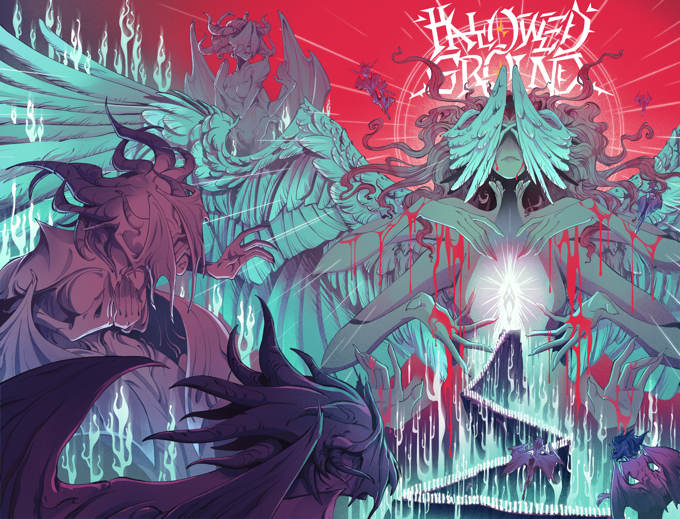
1. What is your favorite word?
Kat: Comics!
2. What is your least favorite word?
Kat: Failure.
3. What sound or noise do you love?
Kat: My dog.
4. What profession other than your own would you like to attempt?
Kat: I was a journalist before I was a full time comic book writer. I’ll always have had a passion for journalism. I’ve really accomplished the two professions I wanted to go into.
5. Please talk about your current writing project…
Kat: Lifeline Comics is best known for our work on Kickstarter, especially our EverAfterVerse titles. We’re working on a crossover now, and can’t wait to get that to people this summer.
We’re always working on a ton of projects, but the books that are most consistent are our WEBTOONS: Slice of Life and Love at Second Bite. It’s exciting to see those queer narratives grow as well.
Okay, now for our portion of today’s program: We here at Wicker Man Studios super love Shakespeare’s play Hamlet. We’ve even written some essays about it… Here’s the first of what we’re calling THE HAMLET PAPERS…
(“Hey, are you going to do some sort of fiction thing involving Hamlet at some point, Barb and Park?”
…It’s a secret. (For now, anyway…))
Is Hamlet’s Father An “Honest Ghost”?
Answer: …As opposed to what, exactly?
There are three points of view concerning the nature of Hamlet’s dead father’s spirit:
1/ King Hamlet’s ghost is a figment of Hamlet’s imagination.
2/ King Hamlet’s ghost is an actual ghost who simply wants vengeance against his brother for murdering King Hamlet and seducing Queen Gertrude (and marrying her).
3/ King Hamlet is a demon from hell.
The first alternative can be dismissed outright, since no less than three reliable witnesses saw the spirit of King Hamlet walking around at night before Prince Hamlet even knew about it. In fact, the first scene in the play shows the audience that this is so, and that we must believe in the reality of the spirit of Hamlet’s father as something that others are capable of seeing, which leaves the other two alternatives.
The answer to the question of the honesty of the spirit of Hamlet’s father depends on semantics. What is, in the play Hamlet, being “honest”?
Some might say that defining honesty in the play is nit-picking. Hamlet’s father told the truth about the murder, so many believe, as Prince Hamlet himself believes, that the ghost must be “honest.”
However, the meaning of words is extremely important in play Hamlet. Prince Hamlet, during his antic disposition, plays with words, twisting words and even sounds with more than one meaning, to make himself seem enigmatic, if not downright insane.
Examples include:
Homonyms such as
* Son/Sun
* Seems/Seams
* Adieu/A dew
* Heir/Air
Also, words that have more than one meaning, such as
* “Fair,” which not only means “pretty,” but also “fair” as in being fair and just.
* “Country” matters being used as a filthy joke.
* “Nothing” between a woman’s legs also meaning a woman’s private parts.
* And—when Hamlet is berating Ophelia—even the word “honest” has more than one meaning. While the most obvious meaning of the word is “are you telling me the truth?” in Shakespeare’s time, the word “honest” also meant chaste, virtuous, reputable, respectable, loyal, virginal, and even faithful. So, when Hamlet asks Ophelia, “Are you honest?” he isn’t just saying “Are you being honest with me?” He is asking if she is loyal, faithful, or even chaste. Hamlet, who says that he is “indifferent honest,” and yet also that he can accuse himself of such sins that it would have been better that his mother had not given birth to him, is using “honest” to mean decent, virtuous, and reputable. Then, Hamlet quite unfairly harangues Ophelia, with the following words:
Ay, truly, for the power of beauty will sooner transform honesty from what it is to a bawd than the force of honesty can translate beauty into his likeness.
What he is saying is that a pleasing shape may transform honesty, in its many definitions, into something that is unvirtuous and unwholesome. A bawd is a pimp or a madam who owns a brothel (which is where we get the phrases “bawdy house” and “bawdy songs”). A bawd is not just a whore, but also a procurer of people’s trust, time, effort, etc. In other words, one’s physical appearance can trick a person into doing something that a person would otherwise be constrained by their conscience into doing. Just as Shakespeare said that “the devil can quote scripture to his purpose,” could not a demon take on a family shape to trick someone into doing something sinful under the guise of doing something just?
Yes, the form/shape of Hamlet’s father told the truth about Hamlet’s father’s murder, but is telling the truth enough to say for certain that the entity walking around in the guise of Hamlet’s dead father is an “honest” ghost?
There are two other important times when Hamlet speaks of honesty that should be addressed at this point. The first is when he runs into Polonius, Ophelia’s father. Hamlet knows that Polonius is very interested in the question of whether or not Hamlet is crazy in his love for Ophelia, since Hamlet has been acting a little crazy lately (for the purpose of trying to throw off suspicion, in those who already know about it, that Hamlet suspects his father was murdered). Indeed, since Polonius is an important servant of the court, who is involved in many activities involving the king, Hamlet has no idea whether or not Polonius might have been asked to spy on Hamlet by Claudius. But one of the main things that Hamlet dislikes about Polonius is how he controls Ophelia and whom she might or might not marry. It is with this background in mind that we read the following passage:
LORD POLONIUS: Do you know me, my lord?
HAMLET: Excellent well; you are a fishmonger.
LORD POLONIUS: Not I, my lord.
HAMLET: Then I would you were so honest a man.
LORD POLONIUS: Honest, my lord!
HAMLET: Ay, sir; to be honest, as this world goes, is to be one man picked out of ten thousand.
LORD POLONIUS: That’s very true, my lord.
Hamlet not only suggests that a fish-seller would be more honest than Polonius, but also, fishmonger, in the parlance of the time, was another word for a pimp. Hamlet has judged Polonius’ honesty, and given him a failing grade, both for speaking plainly and for his morals.
The other instance is when Hamlet is talking to Rosencrantz and Guildenstern. At first, Hamlet honestly appears to be quite glad to see them (Hamlet never uses his antic disposition except defensively, when people come to him and act dishonest, or after they fail one of his tests of honesty)—Hamlet appears grateful that Rosencrantz and Guildenstern have come to visit him. But then it apparently crosses his mind—why have they come to visit him now? Were they, too, sent for by the king to spy on Hamlet? After badgering them for a minute on the question, during which time they have no good alternative answer nor excuses to give, they admit that they were sent for.
HAMLET: What’s the news?
ROSENCRANTZ: None, my lord, but that the world’s grown honest.
HAMLET: Then is doomsday near: but your news is not true.
The best answer I have so far seen about Rosencrantz’s line here is that what Rosencrantz might be saying is that there is no news, everything’s quiet, the threat from Norway seems to have diminished, there’s no danger nor peril, everyone is behaving themselves right now.
But it was Claudius who has negotiated away the immediate threat from Norway, and Hamlet believes that Claudius is not the good king which he wants to be seen as (and Hamlet is correct). Doomsday, biblically speaking, is prophesied to come after evil men take power. So if the world seems to have grown honest, it’s a lie—a dishonest king is on the throne, and therefore calamity for all is surely near at hand. Keeping this in mind, Hamlet next starts pushing Rosencrantz and Guildenstern about whether someone sent for them to come and visit him—and the answer turns out to be yes—it was, in fact, Claudius, the evil man who’s taken power over the country. Rosencrantz and Guildenstern have also failed, which may be why Hamlet seems to mock them when he soon says:
ROSENCRANTZ GUILDENSTERN: We’ll wait upon you.
HAMLET: No such matter: I will not sort you with the rest of my servants, for, to speak to you like an honest man, I am most dreadfully attended.
Keeping this talk of honesty in mind, let us return to the matter of the ghost. Shakespeare’s England was a land still somewhat divided by religion. When Shakespeare first wrote Hamlet, England was a Protestant country, but it had been very firmly Catholic just a short while earlier. Catholics believed that ghosts, in general, might be the spirits of the dead who had returned because of unfinished business. Protestants believed that ghosts, in general, were demons from hell in disguise, sent to cause trouble for the living. This is why the guards who first see Hamlet’s father’s ghost send for Horatio, the scholar; it is hoped that he will be able to decide what to make of it (and perhaps, if he decides for certain that it is a demon, to exorcise or banish it). But the evidence does not seem clear one way or the other, and so the three of them go and tell Hamlet about what they have seen.
What the guards and Horatio see is wearing the entity the shape of Hamlet’s father, but it is also wearing the armor Hamlet’s father wore in life. Since Denmark as a nation is nervous about Norway possibly attacking Denmark, the guards and Horatio agree that the sighting seems like an ill omen. Is the sighting simply an ill omen, or more of a curse on the nation itself?
Horatio, a student at Wittenberg (the University most known for the protestant Martin Luther being a professor of theology there), knows his theology, and therefore he attempts to “test” the entity in a ritualistic fashion. Horatio says that he will “cross” the entity, which means that he will not only make the sign of the cross, but will also speak to it in an ordained way. So, in a way, he will cross-examine it. Horatio demands to know what the ghost’s purpose might be (what news, omens, premonitions, etc. it might have to deliver). Instead of the ghost saying, “I wish to talk to my son” or “I have been murdered by my brother,” the entity looks offended that Horatio dare speak to the entity in such a manner. The entity scowls at Horatio, then skulks away without a word, like a “guilty thing” obeying a summons, right before a cock crows. Roosters crowing to announce that dawn is near, in Elizabethan-era folklore, is a sign that a spirit must return to wherever it may dwell. As the guard Marcellus said about the entity it just saw:
It faded on the crowing of the cock.
Some say that ever ’gainst that season comes
Wherein our Savior’s birth is celebrated,
This bird of dawning singeth all night long;
And then, they say, no spirit dare stir abroad,
The nights are wholesome; then no planets strike,
No fairy takes, nor witch hath power to charm,
So hallowed and so gracious is that time.
Even Horatio has heard of this myth, and believes it “in part.”
What the guards and Horatio have just experienced has been unsettling, and perhaps unwholesome. They have been victims of a frightful time of night, at which any kind of unhealthy supernatural being may dare to stir abroad, enticing the unwary into all manners of wicked activities.
The next time we see the entity, Hamlet has joined the guards and Horatio.
When Hamlet sees the entity, he says:
Be thou a spirit of health or goblin damned,
Bring with thee airs from heaven or blasts from hell,
Be thy intents wicked or charitable,
Thou comest in such a questionable shape
That I will speak to thee.
Unlike Horatio, who is more cautious about the nature of the entity, all it takes to make Hamlet throw caution to the wind is the fact that the entity is wearing a shape that is pleasing to Hamlet’s eyes (and his desire to see his dead father again).
The entity beckons Hamlet to follow it. Hamlet, being impulsive, decides, since the entity looks like Hamlet’s father, to do as the entity commands. The guards and Horatio beg Hamlet not to follow the entity.
Hamlet replies:
Why, what should be the fear?
I do not set my life in a pin’s fee,
And for my soul—what can it do to that,
Being a thing immortal as itself?
It waves me forth again. I’ll follow it.
Notice what Hamlet doesn’t mention here. He thinks that the only aspects of himself that are in danger are his life and soul. However, a human is more than a life and a soul; a human has relationships, standing in one’s community, a conscience, and a mind to protect, too. In fact, Horatio says to Hamlet that Hamlet, by following the entity, might be putting Hamlet’s very sanity at risk. Horatio says:
What if it tempt you toward the flood, my lord,
Or to the dreadful summit of the cliff
That beetles o’er his base into the sea,
And there assume some other horrible form,
Which might deprive your sovereignty of reason
And draw you into madness? Think of it.
The very place puts toys of desperation,
Without more motive, into every brain
That looks so many fathoms to the sea
And hears it roar beneath.
The word “desperation” here actually means “despondency” or “depression.” What Horatio is saying is that the entity could confuse Hamlet’s wits into seeing what isn’t there, perhaps leading to an accidental death, or the entity might change its shape to something so awful to see that it might drive Hamlet mad, or that it might perhaps lure Hamlet to look out at the sea with a nigh-suicidal depression. Horatio has already seen Hamlet’s black clothing and heard Hamlet’s bitter words about Hamlet’s father’s death and Hamlet’s mother’s overly-hasty marriage, so Horatio may be saying that Hamlet, in Hamlet’s anger and grief, may already be a prime target for demonic oppression.
Instead of listening, Hamlet pulls his sword on Horatio and the guards, threatens them with murder if they keep Hamlet from following the entity, and then he runs after the entity. Are these the actions of someone who has seen a ghost, or the actions of someone who is already succumbing to demonic or at least unwholesome influence?
The entity forces Hamlet to walk all over the battlements, full well knowing that Horatio and the guards have decided to follow Hamlet. So, the question that few people ask is this: Why does the entity wish to separate Hamlet from his companions?
Perhaps the answer lies in what Horatio previously said to the entity:
If there be any good thing to be done
That may to thee do ease and grace to me,
Speak to me.
If thou art privy to thy country’s fate,
Which happily foreknowing may avoid,
O, speak!
Could the answer be that there is no good thing to be done that will ease the suffering of the entity, and that the entity has no wish to help Denmark avoid a tragic fate?
Could it be that the entity wishes to speak to Hamlet alone because the entity wishes to connive Hamlet into committing an act of wickedness that would not be of any benefit to the state of Denmark; an act that, if Hamlet’s companions knew of it, they would try to persuade Hamlet not to do?
Perhaps it just wishes to get away from Horatio, who might or might not have the words to drive the entity away if he decided to try to do so…
When Hamlet finally says that he won’t go any further, the entity says:
My hour is almost come,
When I to sulph’rous and tormenting flames
Must render up myself.
The entity has just admitted that it does not come from heaven nor any wholesome version of the afterlife. He has just admitted that he has been consigned to the flames of either hell or Purgatory.
Then the entity’s next words show his agenda:
Hamlet: Speak. I am bound to hear.
Father’s Ghost: So art thou to revenge, when thou shalt hear.
The entity says nothing about wishing to be relieved of the torment he says he suffers. Instead, he wishes Hamlet to be bound to the task of seeking vengeance. Hamlet is really being very incautious here; it is a very bad idea to say that one is “bound” to do anything involving a supernatural being, and the entity certainly immediately jumps on that!
The Bible in both the Old and New Testament tells believers that seeking revenge is a sin. Only God Himself is allowed to take vengeance upon the wicked.
Romans 12:19: “Dearly beloved, avenge not yourselves, but rather give place unto wrath: for it is written, Vengeance is mine; I will repay, saith the Lord.”
Proverbs 20:22: “Say not thou, I will recompense evil; but wait on the LORD, and he shall save thee.”
1 Thessalonians 5:15: “See that none render evil for evil unto any man; but ever follow that which is good, both among yourselves, and to all men.”
Hamlet, being a student at Wittenberg, surely knows that vengeance is sinful in the eyes of God. However, the entity has already admitted that he is going to coerce Hamlet into committing a sin.
In order to do so, the entity does the following:
1/ Proclaims himself to be the ghost of Hamlet’s father
2/ Says that the entity is suffering torments that, if the entity spoke of them, would drive Hamlet mad (so why mention the torments in the first place except to make Hamlet pity the entity?)
3/ Emotionally manipulates Hamlet with the line:
If thou didst ever thy dear father love–
Only then does the entity get down to business by saying:
Revenge his foul and most unnatural murther.
Notice that the entity doesn’t say, “If you ever loved me, you’d avenge my most foul and unnatural murder.” It’s as if the entity is talking about another person entirely.
Hamlet, even before he hears the circumstances of the murder in order to adjudge whether it’s murder at all, says that he will swiftly take revenge.
The entity has already set up Hamlet to sin. Now all that’s left is to make Hamlet hate the murderer just a little bit more.
The entity tells Hamlet that the murderer is none other than Hamlet’s uncle. However, the entity does not start off by telling Hamlet about the murder. Instead, the entity starts out by hitting Hamlet where it really hurts:
…That incestuous, that adulterate beast,
With witchcraft of his wit, with traitorous gifts-
O wicked wit and gifts, that have the power
So to seduce!- won to his shameful lust
The will of my most seeming-virtuous queen.
As a side note, some texts use the word “adulterous” instead of “adulterate,” which has led to the idea that Claudius and Gertrude were having an affair prior to the murder. The true word, however, should be “adulterate,” which means “something poorer in quality,” which makes sense because the entity’s next words are:
O Hamlet, what a falling-off was there,
From me, whose love was of that dignity
That it went hand in hand even with the vow
I made to her in marriage, and to decline
Upon a wretch whose natural gifts were poor
To those of mine!
Notice how every word the entity says is not only similar to sentiments that Hamlet has already expressed in his first soliloquy, but also, the entity is baiting Hamlet by telling Hamlet that Hamlet’s mother, by marrying someone inferior to her first husband, is now a fallen woman.
Is she though? How can a woman who has remarried in an honorable fashion truly be a slut? While the Bible says that a brother-in-law should not marry his sister-in-law, the verse actually says the following:
Leviticus 20:21: And if a man shall take his brother’s wife, it is an unclean thing: he hath uncovered his brother’s nakedness; they shall be childless.
Notice that the rule does not blame the woman for the marriage. It suggests that the man who instigates the marriage is doing an unclean thing, not the woman herself. While husband and wife are said to be one flesh, Claudius’s sins are his own, not his wife’s. Yet, the entity, knowing that Hamlet is enraged and ashamed by Gertrude’s marriage, is ginning up Hamlet’s hatred of Claudius for making his mother (at least in Hamlet’s eyes) a slut. We must also look at where in the Bible the prohibition is: Leviticus is the third book of the Torah, the book of laws for the Jewish people. It could be argued, therefore, that its relevancy to Christian nations such as England and Denmark is more limited than, say, the Ten Commandments.
What is more, marriage is a sacrament that only lasts until a spouse dies. While it may be unseemly and uncustomary that Gertrude married in an overly hasty manner, she did not commit a sin in doing so. Only in the mind of Hamlet himself has Hamlet’s mother defiled initial marital vows.
Perhaps this is why the entity, while demanding vengeance against Claudius, tells Hamlet to not to take revenge on his mother, but to “leave her to heaven,” since she has not committed any kind of mortal sin against her marriage, her son, or her nation.
Getting back to the entity’s demand that Hamlet take revenge upon Claudius: Hamlet’s father tells Hamlet that Claudius poured foul poison in King Hamlet’s ear (just as the entity is pouring the poison of hate into Hamlet’s ear). The entity claims that, because King Hamlet hadn’t had a chance to confess his sins, that King Hamlet is now suffering in the flames:
Till the foul crimes done in my days of nature
Are burnt and purged away.
The question here is, what sins were on King Hamlet’s head that hadn’t previously been forgiven by God? The king, being the head of a Christian nation, surely had prayed and confessed his sins to a confessor so many times that the All Mighty had already forgiven King Hamlet for King Hamlet’s past wrongdoings.
Is King Hamlet actually suffering in flames, or could his soul be in heaven? If King Hamlet is in heaven, then this entity must be a demon—”a goblin damned”—instead of an honest ghost. Some people say, well, if Shakespeare is referencing Catholicism in Hamlet (which would be a little odd, as both England and Denmark were more or less Protestant countries, but Protestantism was fairly new, and it’s hard to be certain when Hamlet is meant to be set), then King Hamlet may well be in Purgatory, since Purgatory is a temporary place where a soul is housed until a soul’s sins are “burnt and purged away,” as the entity says. Even so, if King Hamlet is in Purgatory, one would not think he would necessarily be talking about vengeance. One might more likely think that he’d be begging Hamlet to help get the sullied soul out of Purgatory. To get a soul out of Purgatory, there must be prayers recited, masses and other services performed in the name of the purging soul, and so forth.
However, the entity does not ask for help. Instead, he wants the son of the king to commit a mortal sin. Killing a king (even a conniving, murderous one like Claudius) is regicide, a sin that, under the doctrine of the divine right of kings, would damn a soul to hell for eternity. The divine right of kings believes that God puts rulers on thrones, and that only God Himself can remove a ruler from a throne. Would a father really wish for a loving son to damn the son’s soul just for the sake of vengeance?
Of course, one could argue that in other Shakespeare plays, kings are dethroned because of their wickedness and their lack of right to the throne because of their sins (e.g. Richard III and Macbeth). However, in those plays, regime change was not effectuated by assassinating a ruler. The proper, acceptable-in-the-sight-of-God way to take down a king, according to Shakespeare’s plays, is for one to leave the country, amass allies, amass an army, and then use said army to battle for the throne. If the entity were truly Hamlet’s father—the warrior-king who defeated Norway—wouldn’t the entity say, “My time is brief. Your uncle murdered me. You must find a way to smuggle yourself out of Denmark, to Norway, England, or Germany, and then state your case, get an army, and invade Denmark”?
Instead, the entity gives Hamlet no plan to effectuate regime change, only a warning not to contrive harm against Hamlet’s mother.
Then the entity says:
If thou hast nature in thee, bear it not.
Let not the royal bed of Denmark be
A couch for luxury and damnèd incest.
To translate this phrase into modern English: If you love your father at all, you will not let the current situation in Denmark stand. “Luxury” in Shakespeare’s time meant decadence, overindulgence, excessive sexual activity, lewd desires, and so forth. Note that the entity is equating a marriage—a marriage which the nobles of Denmark, the advisers to King Claudius, and Gertrude herself deemed to be proper—with fornication before marriage. Both the entity and Hamlet himself seem to believe that Gertrude’s vow should surpass “until death us do part,” and that she, like a swan or a mourning dove, should never have another mate in her lifetime… which the sacrament of marriage does not require in any way, shape, or form.
When the entity leaves, Hamlet says something very interesting:
O most pernicious woman!
O villain, villain, smiling, damnèd villain!
Notice that Hamlet’s rage is directed at his mother first, then his uncle. Note, in particular, the word “pernicious.” Pernicious in Shakespeare’s works means “wicked.” However, it means more than just being sinful. In Shakespeare’s plays, “pernicious” also means destructive, someone or something that causes ruin or irreparable damage or even death. Hamlet has tied Claudius’s lust and homicidal nature to Hamlet’s mother, blaming her as much (if not more) for the state of Denmark as he does his uncle’s acts. The entity told Hamlet not to focus on Hamlet’s mother, but to just focus on killing Hamlet’s uncle. The entity did so in order to make Hamlet focus in a laser-sharp manner on killing Hamlet’s uncle. The entity, in ginning up Hamlet’s anger concerning his mother’s marriage, miscalculated. If Hamlet had simply been told that Hamlet’s uncle killed his father, Hamlet might have been more focused on assassinating Hamlet’s uncle. By mentioning “luxury and damned incest,” Hamlet’s singular purpose is distracted by hurt, anger, and outrage toward his mother instead of just feeling vengeful toward his uncle.
After the ghost leaves, Hamlet’s companions appear again. They find Hamlet to be acting strangely gleeful. When Hamlet’s companions ask how Hamlet’s mood is after talking with what they believe to be a ghost, Hamlet says:
Oh, wonderful!
One would expect Hamlet to say that he was afraid, filled with awe, or even filled with pity, grief, and anger, but no, he’s acting pleased—or pretending to act pleased?—with the encounter.
Hamlet proclaims to Horatio, without a hint of doubt of hesitation:
It is an honest ghost, that let me tell you.
When Hamlet is asked what the entity said to Hamlet, Hamlet acts like a child who doesn’t wish to give up a secret. Even after his companions swear not to tell the secret, Hamlet tries to usher them away with the greatest haste, saying:
I hold it fit that we shake hands and part.
You, as your business and desire shall point you—
For every man has business and desire,
Such as it is—and for my own poor part,
Look you, I’ll go pray.
Even Horatio can’t help but notice how unhinged Hamlet is acting. Horatio calls Hamlet’s words “wild and whirling.”
Hamlet makes his companions swear on Hamlet’s sword never to reveal what they saw tonight. Hamlet then tells them that he is going to fake madness, but they must not tell anyone that Hamlet is faking insanity. They are made to swear three times upon Hamlet’s sword. Note that while a sword may look a bit like a holy cross, it is actually an instrument of death, destruction, and violence. So, they are swearing on an instrument of mortality and vengeance instead of a symbol of Jesus Christ resurrected. The companions are forced to swear three times, because whenever Hamlet tried to make them swear, the entity (with a voice that is either coming from underground, from the grave, or from Hell itself), keeps moving around, saying the word “swear.”
Hamlet, in response, keeps on making increasingly giddy jokes about the entity’s status, equating the entity to a mole who digs blindly under the earth.
Hamlet then tells his companions to leave.
Obviously, the entity expected Hamlet to take revenge on Hamlet’s uncle right away. The entity might have at least expected Hamlet to start making revenge plans. Instead, Hamlet spends his time contemplating self-slaughter, insulting his girlfriend’s father, insulting his childhood friends, insulting his girlfriend, watching a troupe of actors orating a scene concerning the Trojan War, berating himself for not taking revenge, then deciding to “test” the honesty of the entity who said it was Hamlet’s father. He chooses to do this with a play he calls “The Mousetrap,” to see if Claudius reacts in a guilty way to the actions onstage that are like those of the murder as the ghost described it to him. In short, Hamlet has spent the last two months doing very little except alienating everyone who he has claimed to love. While such actions can be seen as cruel, they are not, per se, sinful.
In other words, Hamlet is procrastinating.
What happened in the two months following the talk with the entity that caused Hamlet’s purpose to be blunted? Nothing… and maybe that’s the point. No matter how frightening and traumatic it might be to encounter a being claiming to be the ghost of a king, the passage of time heals trauma, and makes one forget the urgency of one’s vows, no matter how sincerely given such vows were at the time they were made.
When Hamlet sees his uncle praying, he could kill his uncle, but Hamlet decides that his uncle’s soul would go to heaven, because all his uncle’s sins would have just been forgiven. Hamlet decides that his revenge is not revenge-y enough. Or maybe his conscience (which makes cowards of us all) tells him that killing a praying man would make Hamlet as big of a villain as his uncle.
This leads us to Hamlet’s talk with his mother in her closet (meaning a small room, such as a sitting room, not a place simply to hang clothes). His anger with his mother is deeper and more violent than his anger towards his father’s murderer. Sexual intercourse with a man who isn’t Hamlet’s father enrages Hamlet more than an actual murder. When Gertrude refers to Hamlet’s uncle as “your father,” Hamlet’s anger is such that Gertrude is afraid that Hamlet may intend to murder her. She screams for help, as does Polonius, who is hiding behind a tapestry.
Only after Hamlet kills Polonius does the entity show up again. Wouldn’t an honest ghost have shown up the second that Hamlet started towards the tapestry, or even before, when Gertrude felt that her life was in danger? Instead, the entity waits until after Polonius is dead to show up again, guaranteeing that Hamlet would have the sin of murder on Hamlet’s conscience. And what does the entity say to Hamlet?
Do not forget. This visitation is but to whet thy almost blunted purpose.
Even after a murder, all the entity cares about is Hamlet’s vow to commit regicide.
So, why didn’t the entity show up when Hamlet started leaving Claudius? Why didn’t the entity say, “Get back in there, boy, and kill your uncle!”? Could it be that the entity could not do so because Claudius was in a chapel, saying holy words in front of a cross?
Whatever the reason, the entity has already ensured that Hamlet has committed a murder, just not the murder that the entity wanted Hamlet to perform. Having led Hamlet into wickedness, the entity does not show up again in the play. One would think that the entity might have said to Hamlet, when Claudius died at Hamlet’s hand, “Well done, sorry you’re dying, but you killed a false king, good for you.”
Perhaps the reason the entity does not appear to gloat is because Hamlet and Laertes exchange forgiveness with one another before dying, which suggests that their souls may have gone to heaven instead of being cast to the flames.
While there is no definitive answer to whether the ghost of Hamlet’s father was really a ghost or a demon from hell, a deep reading of the text of the play certainly makes the latter idea plausible.
To those who say that Shakespeare couldn’t have meant for the ghost to be a demon, let us turn to the play Macbeth. As we’ve learned from the play Macbeth, nothing good ever comes from listening to supernatural beings telling mortals about secret matters. Might Shakespeare not be saying the same thing about Hamlet? The Bible clearly says:
1 Chronicles 10:13-14
13 So [King] Saul died for his transgression which he committed against the Lord, even against the word of the Lord, which he kept not, and also for asking counsel of one that had a familiar spirit, to enquire of it;
14 And enquired not of the Lord: therefore he slew him, and turned the kingdom unto David the son of Jesse.
King Saul consulted with a medium, who let him talk to a spirit of the dead instead of putting his faith in God. By defying God, Saul lost his kingdom to King David.
Hamlet consulted with a spirit, was slain by Laertes, and lost his kingdom to Fortinbras, and in the process, most of the cast were also killed.
The moral of the play Hamlet could well be that when a ghost shows up, follow your smart and loyal friend’s advice and do not follow it—do not speak to it, do not listen to it, do not swear to take action on the ghost’s behalf… and leave vengeance to the Lord.
#Hamlet #Shakespeare #Claudius #Gertrude