
The newest book, entitled PURNAMA (referring to the full moon, which has a key role in the story), will be number 6 in the series, and will be coming out in the fall (of this year).
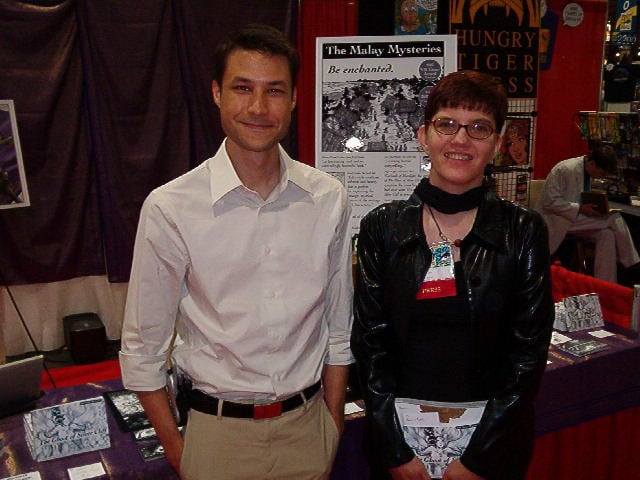
Jai Sen is someone Barb and Park have known for some time now– we first met him years ago at a con.
Recently he sent us his latest work that’s about to come out, Purnama, which will be #6 in the Malay Mysteries series, and he asked us to give him feedback about it.
But… we couldn’t, exactly. I mean, we both read it… although it was hard for Barb to start and then to finish because she knew once she’d read it it would be DONE and she had no idea when she’d get more.
And then after she DID finish reading Purnama, she couldn’t start writing down thoughts about it because she was like “how do you critique something that’s perfect? 10/10? perfection? No notes? How do you give notes on that?”
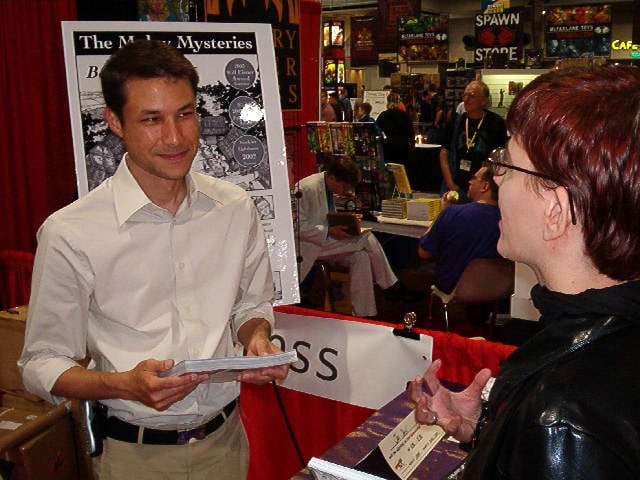
So we did it chat style. Like this:
BARB: Let’s talk about Jai’s new book. It is, of course, astounding.
The quality of his work is consistently great. I’m always eager to read anything he writes. I think his masterpiece is The Golden Vine, which I hope that he reprints someday soon, as I’d love to have a digital copy of it.
But his Malay mysteries are so on my wavelength.
He effortlessly combines folk horror, pan-Asian horror, world mythology, and history.
PARK: Characterization: GO
I mean, start with Marsiti–
BARB: Oh, he is a master at characterization. He makes it all look so easy, which I know it is not.
Let’s start with the current book.
PARK: Right.
BARB: It was a joy to see our two lead characters come back. Seeing a Wise Woman that some call a Witch mentoring her protege is always a pleasure.
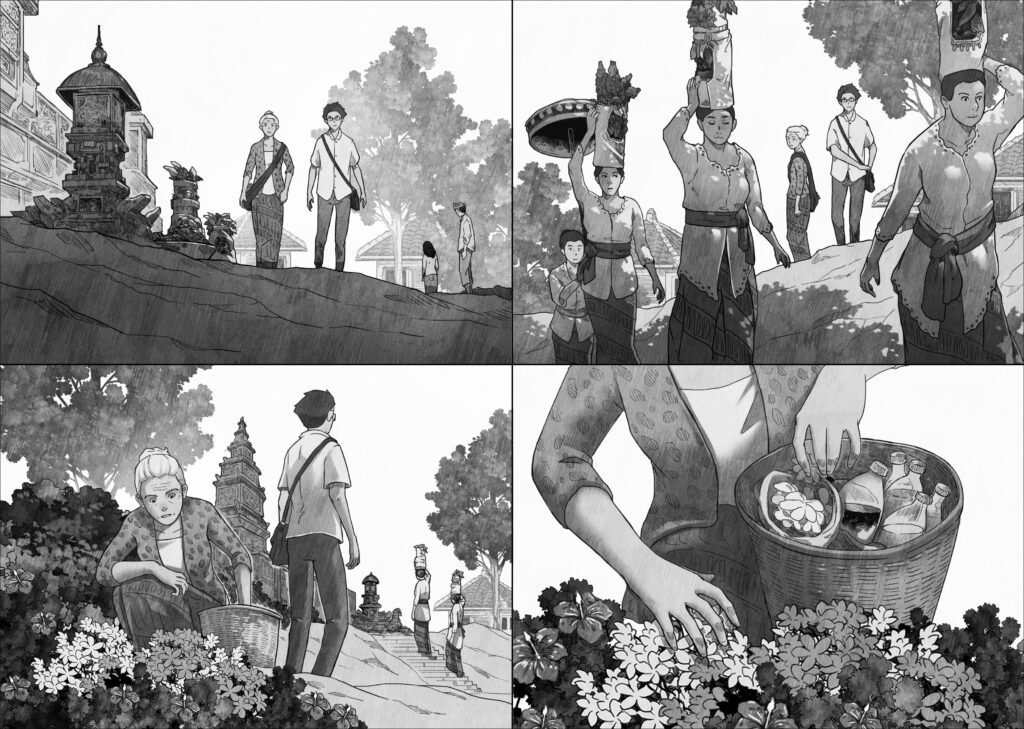
BARB: I hadn’t realized how much I missed these two until I read the latest graphic novel. And I missed the sensibilities of this art approach a lot. The gray scales, the deceptively uncluttered art style. It works perfectly for Jai’s work.
PARK: Marsiti’s always very intense, but seemed especially driven this time, like there’s a ticking clock only she can hear. And yet when they ran into that man, the man whom she realized was under a spell or curse by some sorcerer, that it was too late to help, her empathy and pity were sincere.
BARB: I know! That guy felt like something out of a Maugham story, an unlikeable, arrogant jerk that seemed to look down on everyone, but still she had compassion for the curse or whatever he was under. I wonder if the story will circle back to that guy, as curses are no joke in Jai’s work.
And that isn’t even the main plot!
PARK: Oh, he’ll get back to him, most likely in the very next one…
He’s really setting up some things for the NEXT book here.
BARB: I loved how the witch was drawn to the museum and how they had to break into the museum.
Then, she had to do a ritual to open up a portal to the painting. I mean, could that be more Exhuma?
PARK: Yes, not that Jai’s seen the film Exhuma yet, but he has a lot of postcolonial critique.
BARB: But unlike Exhuma, I do not have to know the history of Indonesia to enjoy the work. With Exhuma, I had to do research afterwards to even understand the plot. Not so with the Malay Mysteries.
PARK: Good point.
Jai once said in an interview:
“Indonesia was under Dutch colonial rule for longer even than the British occupied India. Yet you don’t see nearly the same merging of the two cultures as you did (and still do) in India. In Indonesia, perhaps because the Dutch were there for so long, I had a sense that both sides were really studying each other and still coming up short, and neither seemed to have much interest in assimilating the other (though, inevitably, some of that did happen, a theme I try to explore in a few different ways in the series). With the Dutch and the Indonesians, little moments of exchange could lead to some sort of understanding, but only if the conditions were right.
This was my experience there too, watching multiple cultures interacting with each other. On one hand it was miraculous that there was any sort of cross-cultural understanding at all, but on the other, I’m still puzzled by how some of the people we knew in Indonesia never really got the place, didn’t make much effort to understand and internalize it from within the expat bubble, and still don’t, to this day.”
BARB: You can see how he’s exploring what he in the interview excerpt above with the current Malay Mystery. I mean, here are two guys from two different cultures, trapped in a painting, young, dead, with nothing in common, but eventually, as they had decades to do so, they became friends of a sort.
PARK: Yes.
BARB: And I loved that the characters could not leave the painting until they told their stories. And what stories they were! The Dutch officer wanted a life of adventure and glory. But instead, he got horror and dying young.
PARK: From that same interview: Jai Sen: “If I had to choose one basic theme for the whole series, it’s the issue of being an outsider. Choosing that part of the world as a setting for these stories allowed me to make anyone an ‘outsider’ pretty easily—by showing the interactions of cultures and groups—but also to show that we’re all outsiders, in some way or another. That was my experience going into a culture that wasn’t either of my home cultures, and watching people from other cultures trying to negotiate this shifting boundary.”
And, if I may be so bold, I think that’s one reason you and Jai resonate so much with each other’s works, is because that’s a big theme in all of YOUR works.
It’s just that– in most of your works, the protagonists are Americans who are outsiders in America.
But the common element is acknowledgement of living in a magical and/or supernatural world.
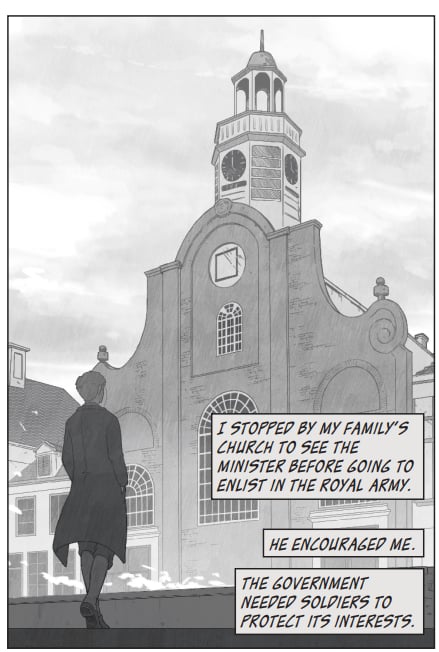
BARB: I’m always into the exiles and outsiders of this world. Now Jai takes a risk here, with not only one but two flashbacks. The Dutch officer realizes that the other soldiers are racist, but he makes a friend that is native to another region of Indonesia (the man in question is Ambonese, from the Maluku islands), and learns about the folklore. That story he’s told about the witch being ambushed, murdered, and turning into a demon was fantastic reading.
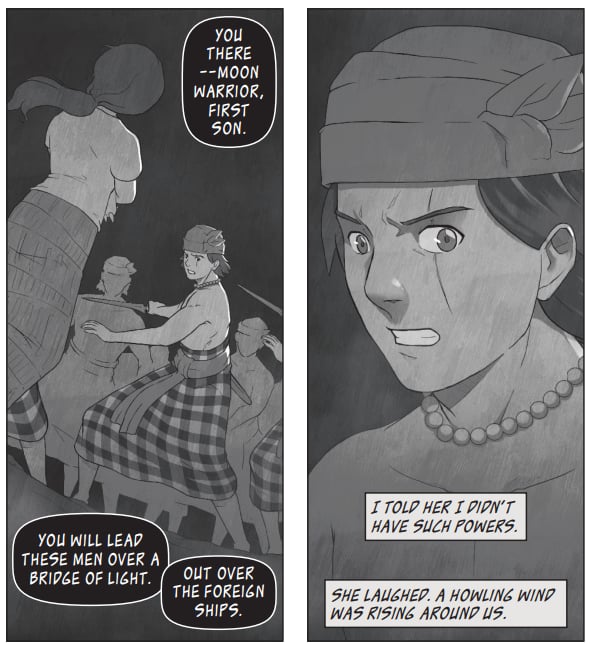
Then the story of the young warrior, trained from the youngest age to be nothing but a fighter– in a culture that on its surface preached non-violence– was heartbreaking. And then the ruler tries to conjure up a protective spirit only to end up with a demon with a child’s face, which is horrifying. And the demon attack aboard the ship? That’s a master class in scares.
I would love to see this series done as an anime, but it would have to be the right studio. This ain’t My Hero Academia!
PARK: Yes. The people who did Mushi-Shi could do it, or Master Keaton. It needs delicacy and nuance.
Except of course I imagine those studios are long gone, but you know, that level of work–
BARB: –Yes, delicacy and nuance! I remember when I was writing the Song To The Siren books that I needed to have the same graceful, delicate, nuanced feel that Jai does so well.
Jai’s work is folk horror done right.
Jai is an intelligent as hell writer, but he’s smart in a way that makes the audience feel smart for keeping up. It takes a very clear writer to be able to do that.
PARK: Ah yes. One is never lost. By using the characters presented, the READER doesn’t feel too much of an outsider.
BARB: It’s very character-based. It’s very subtle. It is done with great care. But, man, he can deliver the scares when he needs to do so.
PARK: It’s a new culture to most readers, but that’s why there’s Hidayat, the Watson/Robin to Marsiti’s Holmes/Batman, to have things explained to.
BARB: Yeah, I need him as the audience identification character. It’s a very clever thing to do.
PARK: Jai, from that interview again: “For me, the medium is very cinematic. I see the scenes as a sort of movie in my head, and try to capture the still images that will make it unfold for the reader the same way it does as I visualize it. I’ve heard comics described as a sort of schematic that the reader decodes into moving images, which is an idea I love, because that’s certainly how I encode them.
Composition and scale are really important in sequential art. One of the ways to control pacing is to use quicker successions of smaller panels to create a rising tension, then suddenly open up to a huge panel, making the reader stop abruptly after racing through pages to follow the fast sequences. This can be accomplished with film, but it’s harder and more obvious. For a series in which I’m showing my readers an unfamiliar place and time, I have to walk a fine line between surprising them visually and keeping them in a comfort zone in which they can feel like they know what’s going on.
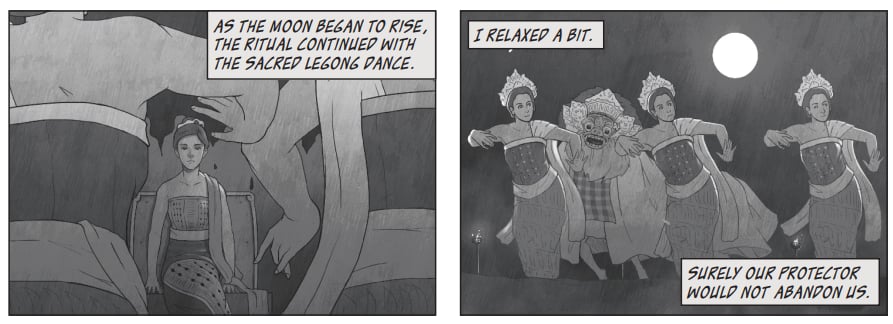
I use a few common tricks in the Malay Mysteries to accomplish what I need to, but mostly, in part due to the small postcard-sized format of the series, I use a very regular rectangular grid that moves along predictably. Partly this is to evoke photos of that time period, as though you’re looking at daguerreotypes from a century ago. It can get a bit restrictive to work in such tiny panels and such a regular grid, but sometimes it’s quite freeing, because I’m not worrying as much about the trickery of odd sized or shaped panels and have a very familiar palette to pick from. The same applies to the decision to make all the books black and white—it simplifies things enormously, and does a lot to evoke the time period.”
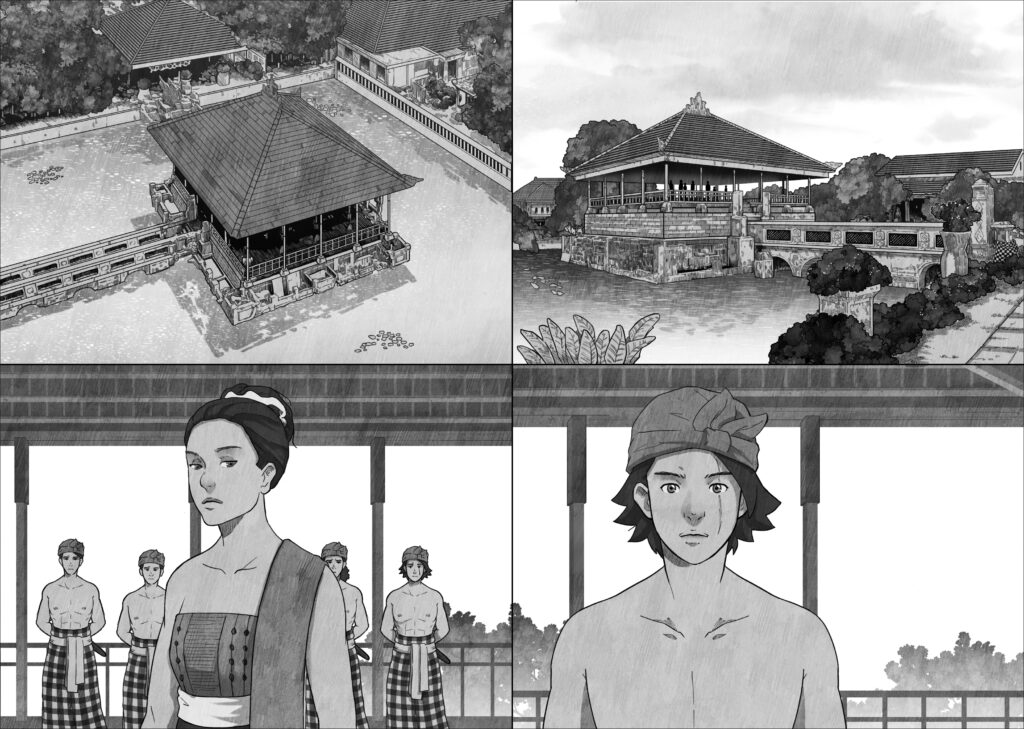
BARB: OMG, that’s the word I was looking for: daguerreotypes! I’m reminded of M.R. James’ The Mezzotint. It gives the work a feeling of early cinema, but also an almost storybook feel.
PARK: I KNOW, RIGHT?
BARB: But I do somewhat the same thing in my Talking Cure series with Zach and Lowman. The difference is that in mine, Lowman is not a nice person. But I adore the idea of fighting the darkness of magic with a lightness of magic the way Jai does in the Malay Mysteries. I always love when the magic experts are the good guys.
I also love that the main character is an older woman, as opposed to someone younger. See, I love unusual relationships in stories. I always look for underexplored relationships in my writing. So, the old but wise woman and the intelligent but naive younger man who could easily pass as her nephew or grandson is right up my alley.
PARK: Right. In this latest book, there’s the political reality, and then the cultural reality, and then the moral reality–
–and then the MAGICAL reality, which involves the last two… and more.
BARB: Exactly!!!
To understand that reality has many layers means one can do so much as an author, but it requires the sort of finesse that an author like Jai has.
Jai Sen’s SHOTO PRESS website: